Key takeaways
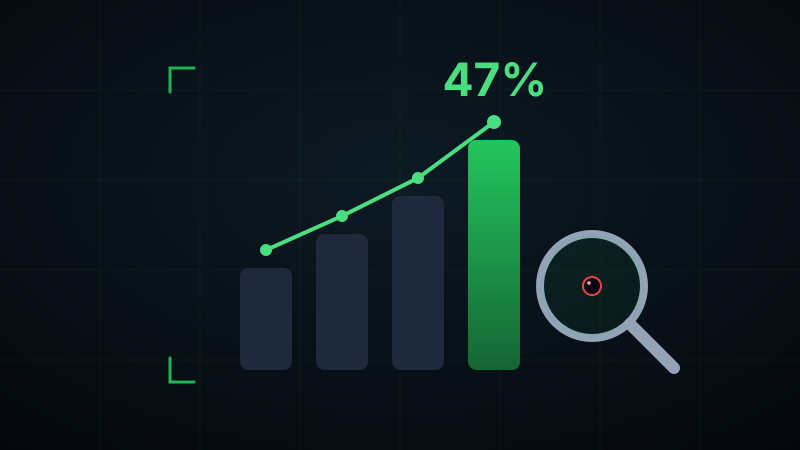
- In IPX1031's 2025 survey, 47% of travelers said they had come across a camera in a rental — up from 25% in 2023.
- CNN's 2024 investigation found more than 35,000 surveillance complaints in Airbnb's own case files over a decade — the firmest number on record.
- Survey percentages are self-reported and vary between studies; court rulings and platform records give the more reliable picture.
Hidden camera and tracker stories can look like isolated incidents — until you line the numbers up. Together they reveal a growing, global epidemic. Here are the most striking figures from recent studies and investigations, and what they mean for your privacy.
The state of vacation rentals
- 47% — travelers who say they have discovered a camera in a rental property, per IPX1031's 2025 survey. In 2023 it was 25%; the figure nearly doubled in two years.
- 1 in 12 — vacation rentals estimated to contain a hidden camera, according to an independent 2024 study.
- 35,000+ — surveillance-device complaints Airbnb received over a decade, uncovered by CNN's 2024 investigation.
- 55% — hosts in the same 2025 survey who admit to still using indoor cameras despite the platform ban.
Sources: IPX1031, 2025 · ConsumerAffairs, 2024 · CNN, 2024
The tracker front
- 317% — the single-year rise in AirTag stalking cases (Cybernews).
- 100+ — tracking-device charges filed in Florida in 2025 alone; the state now treats planting a tracker as a felony punishable by up to 15 years.
- 9 months — how long a flight attendant recorded in airplane lavatories in one US case; the sentence: 18.5 years.
Sources: Cybernews, 2025 · CBS Austin, 2025 · CNN, 2025
The global scale
A February 2026 BBC investigation found more than 180 cameras hidden in hotel rooms in China alone, livestreaming guests to Telegram subscribers — a single channel had 10,000 members. South Korea's 'molka' epidemic continues with thousands of cases a year despite stricter laws, and Türkiye's Sapanca bungalow and Pamukkale rental-flat cases showed the local dimension of the problem.
Sources: BBC, 2026 · Korea Pro, 2024 · Milliyet, 2025 · T24, 2025
What these numbers mean for you
Two clear takeaways. First: hidden surveillance is no longer a marginal, someone-else's-problem risk — if you use short-term rentals, your odds of encountering it are statistically significant. Second: as devices get cheaper and smaller, visual checks alone fall short; 64% of travelers admit they wouldn't know how to detect a hidden camera.
The answer is layered scanning: lens-reflection checks, network and Bluetooth scans, EMF measurement and ultrasonic analysis together leave almost nowhere to hide. SenseRadar combines all of these layers on your phone — a two-minute sweep can keep these statistics from becoming your story.
Frequently asked questions
How common are hidden cameras in holiday rentals?
In IPX1031's 2025 survey, 47% of travellers said they had come across a camera in a rental — up from 25% in 2023 — and one independent 2024 estimate puts roughly 1 in 12 rentals in that category. Those are self-reported figures, so read them as a trend rather than a precise rate.
Are these numbers reliable?
The survey percentages depend on who was asked and how, so they move a lot between studies. The harder numbers come from records: the 35,000+ surveillance complaints CNN found in Airbnb's own case files over a decade, and court cases such as the flight attendant sentenced to 18.5 years for filming in aircraft lavatories.
Where is the risk highest?
Not in a particular country, but in a particular kind of space: somewhere private that a stranger controls and can prepare in advance — short-term rentals, hotel rooms, changing rooms and treatment rooms. The BBC's 2026 investigation in China and the continuing molka cases in South Korea show the same pattern in very different markets.